Dated 3/22/82. Several Maine politicians discuss what it means to them to be Franco-American and the political realities for Franco-Americans in Maine today. Professor James Gallagher, University of Maine sociologist, comments. FOR REFERENCE ONLY.
Interview with Clyde Trudeau by Jack Goldring for The Communist Party of Connecticut Over the Past Fifty Years Oral History Project at Mr. Trudeau's home in Fairfield, April 30, 1987.
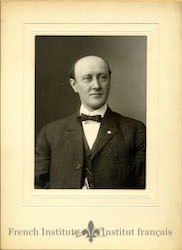
Published by the Boston Review Publicity Service, this small book provides short biographies and images of public officials in Massachusetts, 1927-1928.
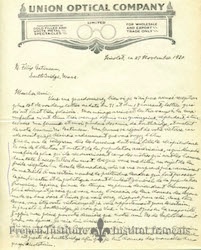
A letter to Félix Gatineau, from J. A. Martin. The letter touches on their friendship, Gatineau's recent election win, a cold welcome Gatineau received from the Cercle Canadien, the status of the local Republican party, and other local news.
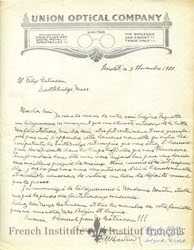
A letter to Félix Gatineau, from J. A. Martin. In the letter Martin congratulates Gatineau on his recent election, having heard the news from Origène Paquette.
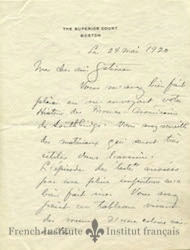
A letter to Félix Gatineau, from Hugo A. Dubuque, a member of the Massachusetts' House of Representatives. Written on stationery from Boston's Superior Court, Dubuque commended Gatineau on his recent publication "Histoire des Franco-Americains de Southbridge."
These are papers that belonged to Dr. S. Alphonse Daudelin and some documentation concerning the 1994 exhibit that was presented in honor of Dr. Daudelin. There are documents from his university years in Montréal as well as many documents concerning the International Maritime Exposition held in Bordeaux in 1907. There is also correspondence with various political figures.
The Levasseur papers are an important record of a committed revolutionary and political prisoner. Beginning with his work in the early 1970s with the Statewide Correctional Alliance for Reform (SCAR), a prisoners' rights organization, the collection includes communiques and other materials from revolutionary groups including the Sam Melville/Jonathan Jackson Unit, the United Freedom Front (UFF), the Armed Resistance Unit, and the Black Liberation Army; Levasseur's political and autobiographical writings; numerous interviews; selected correspondence; and a range of material on political prisoners and mass incarceration.
Consisting in part of material seized by the FBI following Levasseur's arrest or recovered through the Freedom of Information Act, and supplemented by newsclippings and video from media coverage, the collection has particularly rich content for the criminal trials of UFF members and the Ohio 7 seditious conspiracy case, as well as Levasseur's years in prison and his work on behalf of political prisoners.
Although the collection is organized roughly into three series -- Writing and radicalism, Trials, and Prisons, and political prisoners -- there is considerable overlap.
Oral history with the Mayor of Holyoke, about his interest in politics, his belief in cultural pride, the Franco-American community in Holyoke and Massachusetts, and its traditionally low level of political participation and voting at the local and state level.
Correspondence, biographical material, writings, scrapbooks, subject files, newsclippings; pamphlets, manuals, and other printed materials; and memorabilia related to Belanger's union and election activities, and his work with various government agencies and commissions. Scrapbooks comprise the bulk of the collection and include correspondence, news clippings, photographs, postcards, and various memorabilia. Correspondents include: the U.S. Conciliation Service of the U.S. Department of Labor; the National War Labor Board; the War Manpower Commission of the Office for Emergency Management; the League of Women Voters of Massachusetts; the Council for Constitutional Reform in Massachusetts, Inc.; and The White House.
From the Collection: This series consists of three subseries organized by format - cassette tapes, open-reel tapes and phonograph records. The contents are similar in that they consist of recordings of Muskie's speeches and other public remarks, including question-and-answer sessions, press conferences, radio and television interviews and news broadcasts, campaign spots for broadcast over radio or television, and congressional hearings. Almost all were made by Muskie's Senate or campaign staff for later reference. The recordings also contain a large number of audio press releases, called "beepers", prepared by Muskie's senate staff.
Most of the open-reel tapes were recorded in the 1960s, but that subseries also includes a wire recording of a 1954 Democratic program and a contemporaenous Republican television program, which includes remarks by Vice President Richard M. Nixon. Starting in 1968, the staff increasingly relied on cassette tapes. The cassette tapes include a recording from 1958 (originally recorded on an open-reel tape player, but donated to the archives on a cassette tape) in which Muskie shared an Old Orchard Beach stage with Louis Armstrong and Bette Davis. The cassette tapes also include brief journal entries from Muskie and several members of his staff.
From the Collection: This series consists of three subseries organized by format - cassette tapes, open-reel tapes and phonograph records. The contents are similar in that they consist of recordings of Muskie's speeches and other public remarks, including question-and-answer sessions, press conferences, radio and television interviews and news broadcasts, campaign spots for broadcast over radio or television, and congressional hearings. Almost all were made by Muskie's Senate or campaign staff for later reference. The recordings also contain a large number of audio press releases, called "beepers", prepared by Muskie's senate staff.
Most of the open-reel tapes were recorded in the 1960s, but that subseries also includes a wire recording of a 1954 Democratic program and a contemporaenous Republican television program, which includes remarks by Vice President Richard M. Nixon. Starting in 1968, the staff increasingly relied on cassette tapes. The cassette tapes include a recording from 1958 (originally recorded on an open-reel tape player, but donated to the archives on a cassette tape) in which Muskie shared an Old Orchard Beach stage with Louis Armstrong and Bette Davis. The cassette tapes also include brief journal entries from Muskie and several members of his staff.
From the Collection: This series consists of three subseries organized by format - cassette tapes, open-reel tapes and phonograph records. The contents are similar in that they consist of recordings of Muskie's speeches and other public remarks, including question-and-answer sessions, press conferences, radio and television interviews and news broadcasts, campaign spots for broadcast over radio or television, and congressional hearings. Almost all were made by Muskie's Senate or campaign staff for later reference. The recordings also contain a large number of audio press releases, called "beepers", prepared by Muskie's senate staff.
Most of the open-reel tapes were recorded in the 1960s, but that subseries also includes a wire recording of a 1954 Democratic program and a contemporaenous Republican television program, which includes remarks by Vice President Richard M. Nixon. Starting in 1968, the staff increasingly relied on cassette tapes. The cassette tapes include a recording from 1958 (originally recorded on an open-reel tape player, but donated to the archives on a cassette tape) in which Muskie shared an Old Orchard Beach stage with Louis Armstrong and Bette Davis. The cassette tapes also include brief journal entries from Muskie and several members of his staff.
From the Series: This sub-subseries includes the following types of files from the 94th Congressional Session: case files (including academy files); correspondence files; political files; press files; resource files; scheduling files; sponsorship/cosponsorship files; personal files of Muskie, James W. Case and William S. Cohen; and a small number of miscellaneous files.
These files include substantial documentation on the Maine Indian land claim case; clean air and water legislation; the work of the Senate Budget Committee and the Subcommittee on Intergovernmental Relations, both of which Muskie chaired; and Muskie's responses to U.S. Supreme Court decisions. Additionally, the political files from this congressional session include information about the 1972 and 1976 Presidential election processes.
"VISIT AND HEAR U.S. SENATOR EDMUND S. MUSKIE . . . CELEBRATE MAINE'S SESQUICENTENNIAL FRENCH CANADIAN DAYS" 14" x 22" From the Series: This subseries comprises artifacts that were manufactured for a specific, limited use related to politics or a poiltical campaign. It includes items such as buttons, bumper stickers, posters, and miscellaneous promotional items, as well as original political cartoons.
From the Collection: This series consists of three subseries organized by format - cassette tapes, open-reel tapes and phonograph records. The contents are similar in that they consist of recordings of Muskie's speeches and other public remarks, including question-and-answer sessions, press conferences, radio and television interviews and news broadcasts, campaign spots for broadcast over radio or television, and congressional hearings. Almost all were made by Muskie's Senate or campaign staff for later reference. The recordings also contain a large number of audio press releases, called "beepers", prepared by Muskie's senate staff.
Most of the open-reel tapes were recorded in the 1960s, but that subseries also includes a wire recording of a 1954 Democratic program and a contemporaenous Republican television program, which includes remarks by Vice President Richard M. Nixon. Starting in 1968, the staff increasingly relied on cassette tapes. The cassette tapes include a recording from 1958 (originally recorded on an open-reel tape player, but donated to the archives on a cassette tape) in which Muskie shared an Old Orchard Beach stage with Louis Armstrong and Bette Davis. The cassette tapes also include brief journal entries from Muskie and several members of his staff.
From the Collection: This series consists of three subseries organized by format - cassette tapes, open-reel tapes and phonograph records. The contents are similar in that they consist of recordings of Muskie's speeches and other public remarks, including question-and-answer sessions, press conferences, radio and television interviews and news broadcasts, campaign spots for broadcast over radio or television, and congressional hearings. Almost all were made by Muskie's Senate or campaign staff for later reference. The recordings also contain a large number of audio press releases, called "beepers", prepared by Muskie's senate staff.
Most of the open-reel tapes were recorded in the 1960s, but that subseries also includes a wire recording of a 1954 Democratic program and a contemporaenous Republican television program, which includes remarks by Vice President Richard M. Nixon. Starting in 1968, the staff increasingly relied on cassette tapes. The cassette tapes include a recording from 1958 (originally recorded on an open-reel tape player, but donated to the archives on a cassette tape) in which Muskie shared an Old Orchard Beach stage with Louis Armstrong and Bette Davis. The cassette tapes also include brief journal entries from Muskie and several members of his staff.
From the Series: The Waterville Office functioned as Muskie's primary office in the State of Maine for his entire Senate career. The records from that office include case and project files; carbon copies of correspondence sent from both the Waterville and the Washington offices; press files; correspondence and related documents on the 1960, 1964, 1968, 1970 and 1972 election campaigns; an "information/resource file" consisting of newspaper clippings on state and national topics; office management files; publications of congressional hearings; and some personal material such as Muskie's income tax returns and bank accounts. This sub-subseries also contains a file of typescript copies of Muskie speeches, mainly those given in Maine, dating from 1955 to 1972.
From the Collection: This subseries includes sets of files that span multiple congressional sessions and that summarize Muskie's senate career. This subseries is divided into two types of files, those containing Muskie's legislative and voting records, and those containing copies of Muskie speeches, press releases, reprints and the like. This subsereis also contains a folder of file codes used in the Washington senate office between 1970 and 1976.
From the Collection: This subseries includes sets of files that span multiple congressional sessions and that summarize Muskie's senate career. This subseries is divided into two types of files, those containing Muskie's legislative and voting records, and those containing copies of Muskie speeches, press releases, reprints and the like. This subsereis also contains a folder of file codes used in the Washington senate office between 1970 and 1976.
From the Collection: This subseries includes sets of files that span multiple congressional sessions and that summarize Muskie's senate career. This subseries is divided into two types of files, those containing Muskie's legislative and voting records, and those containing copies of Muskie speeches, press releases, reprints and the like. This subsereis also contains a folder of file codes used in the Washington senate office between 1970 and 1976.
Interview includes discussions of: Aroostook County, 1946-1999; Maine Democratic Party post- 1946; Party organization; Violette’s contributions to the 1960s Maine legislature; the seclusion of Aroostook County; Dickey-Lincoln; Allagash Wilderness Waterway; Sumner Pike; running against Margaret Chase Smith; 1968 Maine Convention debates; Ed Muskie’s 1968 Vice Presidential campaign; Congressional campaigns of the early 1970s; politics as a justice; Bob Haskell; and John Martin.
Interview includes discussions of: Violette family history; Van Buren, Maine history; unions; Catholicism; Maine House of Representatives in 1946; Muskie in the Maine State Legislature; and St. John Valley, 1919-1948.
Interview includes discussions of: Van Buren, Maine community; Elmer Violette; Glen H. Manuel; Allagash Wilderness Waterway; Land Use Regulation Commission (LURC); and the World War II generation.
Interview includes discussions of: Elmer Violette and his work on the Allagash Waterway bill; John Martin and the influence of Claude Martin and Elmer Violette; and theVan Buren, Maine area.
Interview includes discussions of: family political and social views; boarding school; Boston College and religion; Bowdoin College; growing up in Waterville, Maine; John H. Reed; Office of Economic Opportunity; Labor Department; Opportunity Industrialization Centers of America; minimum wage laws; marriage to Betsy Carpenter; Ken Curtis; James Longley; confirmation process; tripartite commission on labor; Jimmy George; 2000 election; Republican control of Maine politics; Muskie as politician; recent jobs; Jane and Ed Muskie as friends; Ed Muskie’s temper; first meeting of Jane Gray and Ed Muskie; Muskie’s early political positions; Don Larrabee; Muskie’s final years; arguments with Muskie; property tax; and Muskie’s effect on the balance of political power in Maine.
Interview includes discussions of: Lewiston in the 1930s; Rocheleau’s Navy service; his attendance at law school; helping Muskie run for Governor; confrontations with Louis Jalbert; not being supported in the primaries; Robert Couturier; Lewiston politics in the 1960s; running for Mayor; confrontations with Denny Blais; Democratic split in Lewiston; “Ruining” the Democratic party in Lewiston; running for District Attorney; George Call in Lewiston; Mayoral appointments; racial relations in Lewiston; urban renewal money problems; trying to get Federal money redirected to Lewiston; his relationship with Ken Curtis; Ken Curtis’ role in urban renewal; help securing project funds from a New York Secretary; securing the land for Lewiston High School; meeting Ed Muskie; serving for Ken Curtis; Independence in Maine politics; supporting Nixon in 1968; getting silenced by the Democratic Party; his later political career; and Muskie’s contribution to Maine.
Interview includes discussions of: family background; Housing and Urban Development (HUD) office in Portland; Patrick Tremblay; Lewiston ethnic make up; urban renewal; Bill Hathaway’s congressional campaign; campaigning strategies; his father’s political career; legal atmosphere of Lewiston; Lewiston politics; Ernest Malenfant; Lewiston mayoralty; and Louis Jalbert.
Interview includes discussions of: family background; Waterville community and education; Colby College; campaigns with Ed Muskie; dinner parties with the Muskies; community perceptions of Muskie; conversations with Ed Muskie; personal career and family life; Muskie’s political work for Waterville and Maine; and local environmental effects.
Interview includes discussions of: Pontbriand family history; religion in Lewiston-Auburn; the French Language in Lewiston-Auburn; Lewiston French media in the 1940s; Louis-Philippe Gagne; the Couture family; Franco-American attitudes toward marrying other groups; University of Maine, 1946-1950; getting out of the family business; getting into the ski business; Lost Valley Ski Area history; politics growing up in New Auburn; Louis Jalbert; political make-up of Auburn; trolley transportation in Lewiston-Auburn; and Pontbriand hardware store.
Interview includes discussions of: political, cultural, and economic dynamics of Old Orchard Beach, Maine; Office of Price Stabilization (OPS); first encounter with and impressions of Muskie; 1960 presidential election; Public Utilities Commission (PUC); Archives bill; Hildreth- Clauson debate; being a congressional aide to Peter N. Kyros, Sr.; Anderson bill; value of political contacts; AARP; and the Saco Bay Planning Commission.
Interview includes discussions of: Rumford, Maine; Stephen Muskie’s tailor shop; Ed Muskie; Worumbo Mill in Lisbon Falls; decline of Maine mills; and recollections of Stephen Muskie: his personality and reputation.
Interview includes discussions of: Rumford, Maine community in the 1950s and 1960s; how Muskie helped Carmelle’s family; Oxford Paper Company; description of Cape Elizabeth in the 1950s and 1960s; Model Cities in Portland; City Council, Portland; Housing and Urban Development (HUD) in Portland; the Citizens Advisory Committee; West End Neighborhood Center; People’s Building; Youth in Action; Holy Innocence Homemaker Program; Twenty- four Hour Club; Serenity House for alcoholics; Our Place; Community Health Services; Jerry Conley Sr.; the impact of tourism on Portland; the impact of recent influx of immigrants on Portland; Catholic Charities Refugee Program; mill towns like Lewiston and Rumford; Bates College; mercury scare in fishing industry in the 1960s; and the fishing industry in Maine.
Interview includes discussions of: 1954 Maine gubernatorial campaign; 1969-1972 presidential campaign; environmental protection; Model Cities, Lewiston; Greek community in Lewiston and Maine; big box voting; social clubs and voting in Lewiston; anecdote about 1954 campaign about picklemaker; U. S. Conference of Mayors; National League of Cities; Maine Legislature; Louis Jalbert; Democratic National Convention in Miami 1972; Maine Municipal Association; Tax Reform Act of 1986; Severin Beliveau; Bill Hathaway; John Baldacci; Margaret Chase Smith; David Emery; and Olympia Snowe.
Interview includes discussions of: environmental protection; Democratic Party in Maine; Maine Legislature (1975 to 2001); highways and roads; paper mills and unions; Great Northern Paper Company; education funding; the Maine University system; and health care.
Interview includes discussions of: family history; legislative career overview; teaching and other early jobs; family involvement in politics; childhood experiences with ethnicity; social cliques at college; anti-French professor at UMO; political activism at UMO; influences before college; summer work after high school; Floyd Powell; influences at Orono; friends at Orono; Democratic state legislators in the ‘60s and ‘70s; early memories of Muskie, dual membership in Young Democrats and Young Republicans; Chubb Clark’s loyalty test; early work for Muskie; confrontation with Howard Hughes’ aide; liaison work with Secret Service; Muskie’s ‘68 campaign; ‘70 and ‘72 campaigns; impressions of other members of Muskie’s staff; Dickey Lincoln and Allagash Waterway projects; and his work in Connecticut.
Interview includes discussions of: military service; Lewiston/Auburn automobile dealerships; Center St. Auburn development; Lewiston snow storm election of 1951; Lewiston/Auburn tensions; relations between Franco-Americans and Yankees; Lewiston Development Department; Frank Coffin; and merging Lewiston and Auburn.
Interview includes discussions of: Lewiston, Maine in the 1920s and 1930s; Catholic organizations; the Great Depression in Lewiston; Lewiston Catholic schools; political change in Lewiston; Louis Jalbert; Little Canada in the 1940s; Lewiston's downtown; Steckino's restaurant; Ed Muskie's influence on the Lewiston area; childhood skating in Lewiston and Auburn; and the Nichols Tea Room.
Interview includes discussion of: Van Buren, Maine; the US Army in Europe during World War II, including beach Landings, heavy machine guns, Levesque’s capture by the Germans, and German war hospitals and the care for Allied fighters; Frazier Paper Mill; becoming the Union President of Local 365; organizing voters in the St. John Valley for Ed Muskie in 1954; becoming Democratic Chair of Madawaska; Muskie’s interaction with the Valley; Don Nicoll; the rise of Democrats in Maine; Levesque’s involvement with the Maine State Legislature; Levesque as a legislator; Loring Air Force Base; Floyd Harding; Elmer Violette; John Martin; and Muskie as a leader.
Interview includes discussions of: Richelieu Club; Jean Charles Boucher and his career; Lewiston City Charter in 1939; Lewiston mayoral election between Pa Gould and Jean Charles Boucher; WAFU French radio station; Franco-American influence in Lewiston in 1920s, 1930s and 1940s; Great Depression in Lewiston; and Bates College 1952 to 1956.
Interview includes discussions of: Brooks Quimby; Bates College; working with Ed Schlick in Augusta; treatment of Lemieux by Muskie’s staff after writing critical articles; Burt Cross’ mistakes in his reelection campaign; Le Messager (French newspaper in Lewiston); Ernest Malenfant; and Jean Charles Boucher.
Interview includes discussions of: Bates College; Maine Legislature 1946-1949; 1952-1954 Maine Democratic Party; 1954 Maine gubernatorial campaign; Burt Cross’ campaign mistakes; polio known as blue fever; difficulty for Francos in Augusta public schools; father was Justice of the Peace: a notaire; Snoop Cat: Bates College publication; Brooks Quimby; Edna Confort; Irving Isaacson; Fernand Despins; Lewiston Charters; Council components; Lewiston/Auburn media, Evening Journal and Le Messager; atmosphere among State House reporters; Sun and Journal rivalries; Democrats could caucus in a telephone booth; Republican Party in Maine; Governor’s Council; 1951 Liquor Probe; impressions of Muskie; evolution of news business; Frank Hoy; and WLAM radio station.
The interview includes discussions of: Muskie’s 1972 Presidential campaign; Muskie’s 1976 Senate campaign; Muskie’s years as Secretary of State; the Budget Act of 1976, the Budget Committee, 1976-1980; environmental protection; the Intergovernmental Relations Subcommittee; housing, including the rehabilitation and subsidization of public housing; her Senate legislative work; Muskie’s sincerity, dedication and temper; Sunshine Government; the Sunset Act which makes legislation periodically expire to see if it is worth having; Maine getting an extra million dollars from Dept. of Health, Education and Welfare in 1973; Muskie’s late career, his 80th birthday party in Washington and Lewiston at the Ramada Inn, and his funeral two years later; Social Security benefits for college students with a deceased parent and surviving parent only working part time; French-Canadian migration to industrial centers of Maine; lack of interest in higher education among Franco-Americans of previous generations; depression as contributing to previous generations’ view of the importance of college; changing social mores of high school; first surgeon general’s warning about smoking in 1963; Nixon’s freeze on government hiring; rebuilding Muskie’s staff in 1976 with Maine people; acquiring Gov. Curtis job through contact with Georgette Berube and Bob Couturier (judge of probate); working on projects in Muskie’s office; her impression of pre-Indian Land Claims Settlement Act of 1980; Washington lobbyists as supplicates; transition to Mitchell from Muskie in the Senate, and Mitchell asking staff to stay until Election of 1982; her impression of differences in partisanship between time of Watergate and Clinton impeachment; Democratic control of both houses of Congress and presidency between 1976 and 1980; Reagan’s landslide win and Congressional shifts; the reauthorization of the Clean Water Act; Mitchell’s gubernatorial bid in 1974; U. S. attorney, 1978; Federal judge, 1979; Emery challenge 1982; her impression of decrease in political involvement and increase in those unenrolled in political party as a byproduct of partisanship in politics; the 1986 election in which Democrats retook the U. S. Congress, Mitchell as majority leader; in 1984, Deputy President Pro Temp created for Mitchell in the Senate; the impeachment of Clinton; the Maine State legislature as part-time, under funded, and under staffed; “citizen legislature” as obsolete because of complexity of legislation; political term limits; the Libra Foundation; and the Dinner for Women Lawyers in Maine with Gloria Steinem as speaker.
Interview includes discussions of: Maine Legislature 1946-1949; 1955-1956 gubernatorial term; 1957-1958 gubernatorial term; 1958 U.S. Senate campaign; 1968 vice presidential campaign; 1969-72 presidential campaign; 1970 U.S. Senate campaign; Roosevelt-Campobello International Park Committee (RCIPC); Intergovernmental Relations (IGR) (CETA Program); Emergency Employment Act of 1971; Democratic Party in Maine; Lewiston community history; Lewiston during the Great Depression; Roland’s brother being killed in World War II; vigilantes organization; delegate to 1968 Democratic National Convention; Louis Philippe Gagne’s political career; and insight into Franco-American culture in Lewiston.
Interview includes discussions of: family and personal background; Waterville, Maine community; meeting her husband, Charlie; various jobs; first impression of Ed Muskie; driving with the Muskies; picture with the Queen Mum; Secret Service parties; Washington, DC in 1968; Marjorie Hutchinson; William Loeb/Manchester incident; Muskie’s Washington staff; Charlie’s involvement with Muskie; Alice’s relationship with the Muskie family; Muskie’s later years in office; Muskie’s temper; and Muskie’s legacy.
Interview includes discussions of: World War II; ethnic makeup of Bangor, Maine; family background; Big Box voting; political makeup of Bangor; 1968 Maine campaigns; Maine legislature, 1968 to1984; Muskie gubernatorial race; going to church with Muskie; Ralph Owen Brewster; the Cohen family; Bill Hathaway; John Martin; and Louis Jalbert.
Interview includes discussions of: connection between Lewiston and Quebec in the 1930s-1940s; Robert Wiseman; bootlegging; “Wiseman Gang” of Paul Couture, Al Lessard, Jere Clifford, Robert Caron, Roland Tanguay, and Louis Jalbert; Lewiston political cliques; Muskie as a legislator; Ernest Malenfant; legislative issues of the 1950s; Frank Coffin; Le Messager; Richard Sampson; running for Senate President; determining Lewiston political line-ups; television; Ed Muskie story: convention 1960; lobbying for Kennedy at the 1960 convention; run-ins between Louis Jalbert and Bill Jacques; urban renewal; difference between Lewiston and the St. John Valley; airport politics; Kennedy visit to Lewiston; Clay-Liston fight in Lewiston; Ed Muskie’s impact on Maine; and Androscoggin County jail reconstruction.
Interview includes discussions of: family and educational background; interest in politics; 1960 presidential nomination; Maine legislature; 1972 presidential campaign; Muskie’s campaign for reelection to the Senate in 1976; Muskie’s pro-war stance; Muskie’s appointment as Secretary of State; 1980 Democratic National Convention; Muskie’s environmental legislation; and connections to various political figures in Maine.
Interview includes discussions of: family background; Lucille Abbott; the draft; Oxford Paper Mill; serving as Fire Chief; Edmund S. Muskie; Rumford, Maine community; George Mitchell; class reunion; and the Senior Citizen Club.
Interview includes discussions of: Waterville law practice; 1954 Maine gubernatorial campaign; 1957-1958 Muskie’s second term as governor; urban planning and development; Democratic Party in Maine; community history of Lewiston; first industrial park in Maine; Bates Mill textiles; ethnic intolerance (specifically involving Francos) in Portland, Boothbay Harbor, and Lewiston schools (Irish v. French tensions); Model Cities program; Robert Couturier; Goulet’s wife drove Longley’s Winnebago during 1974 gubernatorial campaign; and Goulet was Frank Coffin’s right hand man when he lost gubernatorial race in 1960.
Interview includes discussions of: Hal Gosselin’s career; personal recollections of Margaret Chase Smith; Muskie in New Hampshire; Jim Longley’s “kitchen cabinet” and Bob Pachios and Hal Gosselin; Denis Blais; Ernest Malenfant; Louis Jalbert; changes in Lewiston-Auburn; Lucien Gosselin; Muskie’s accomplishments; and Maurice Goulet.
Interview includes discussions of: the exodus of Lewiston’s textile industry; difficulties attracting new industry to Lewiston/Auburn; downtown Lewiston; urban renewal grants; religion in Lewiston and Auburn; French heritage as a community asset; the “Democratic machine” of Lewiston; Lewiston getting “short changed” by Maine State government; social clubs; Lower Lisbon Street in Lewiston; the 1939 Lewiston Charter; the 1980 Lewiston Charter; Federal grants causing municipal re-organization; setting up a “Council-Administrator” form of government; Lewiston Auburn College; Gosselin’s personal education experience; Ernest Malenfant; Paul Couture; Maurice Goulet; and Mario’s Restaurant.
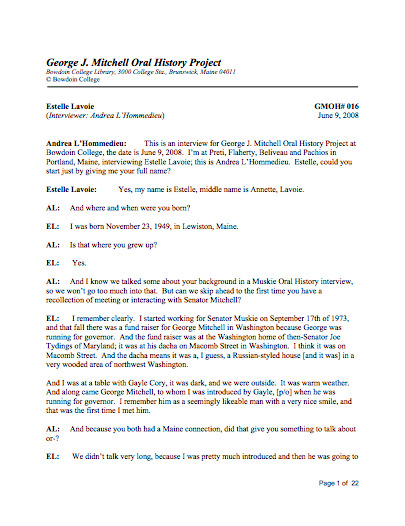
Interview includes discussions of: growing up in Lewiston; the Roman Catholic Church in Lewiston; the Franco-American community of Lewiston; French language in Catholic schools; his experiences working at Lewiston newspapers; Victor News; civil defense in Lewiston; the Lewiston City Charter of 1939; the Lewiston City Charter of 1980; economic development at the municipal level; Faust Couture; Franco-American media in Lewiston; Bill Rocheleau; Louis Jalbert; block voting for state representative; John Aliberti; Hal Gosselin; Al Cote; John Orestis; Ed Muskie fundraiser for George Mitchell; Estelle Lavoie; being a Democrat in Lewiston; and Muskie in Washington.
Interview includes discussions of: Maine newspapers; Hal Gosselin; “Lal” Lemieux; Louis Philippe Gagne; Faust Couture; WCOU; Hal’s involvement in Chamber, Junior Chamber, Elks Chamber, United Fund, Bates Manufacturing, CMMC, City Controller; Hal’s relationship with Margaret Chase Smith; attending Nixon and Johnson inaugurals with Hal; Hal’s impression of Muskie; Hal with John Beliveau ; Hal and public relations for Bates Manufacturing Company [Bates Mill]; Denis Blais; “Teas” (women and fund raisers); St. Mary’s May ball ; evolution of women’s group meetings; and Bates Mill potential.
Interview includes discussions of: Lewiston political history; environmental protection work; Anti-Vietnam War movement; Democratic Convention of 1968; Civil Rights movement in Maine; Maine politicians; “English Only” Bill; Maine Commission on Legal Needs; and Muskie’s environmental work.
The interview includes discussions of: Bates College; track; Muskie’s roommate Joe Biernacki; the Navy; Muskie presenting an award to Gautier; Muskie leading a parade in Auburn; the Democratic Party in Maine; differences between Lewiston and Auburn (L/A); “Loiston”; local students at Bates; tension between Bates and L/A; similarities between Bates and a teacher’s college; the percentage of Bates from L/A; the division between men and women at Bates; the Depression affecting everyone; cars on Bates campus then and now; Auburn as being Republican, and Lewiston as being Democrat; the postmaster as a political appointment; the ten point preference in civil service; the changing position of postmaster; 1974 political issues; 5 cent deposit on aluminum cans; teachers’ salaries; the influence of Kiwanis, Exchange, and Rotary in the 1950s; the Bates transition from conservative to liberal and the possible influence of war.
Interview includes discussions of: Bates College; 1954 Maine gubernatorial campaign; 1955- 1956 Governor 1st term; environmental protection; Model Cities; Boys’ and Girls’ State; the Great Depression; World War II; League of Women Voters; and legal services for the elderly.
Interview includes discussion of : Northern Maine during the Depression; Joe Freeman; getting into the restaurant business; operating a Presque Isle restaurant during WWII; becoming a Pepsi bottler; registering Democrat in Northern Maine; 1954 Democratic campaigns; Ed Muskie’s progression in politics; Joe Freeman’s political ambitions; and meeting the Muskies in Washington.
Interview includes discussions of: F. Harold Dubord’s relationship with Ed Muskie; his parents’ political backgrounds; Knights of Columbus; playing saxophone to save money in high school and college; China Lake; parental influences on Richard and Robert Dubord; the 1954 campaign; Waterville political and ethnic make-up in the 1930s; Colby’s move from downtown to up on the hill; election between Joe Jabar and Spike Carey; fishing with Don Nicoll; qualities of Ed Muskie; Frank Coffin; Maine’s progression from an extremely Republican state to more Democrat with Muskie and Coffin; and playing golf with Muskie.
Interview includes discussions of: 1980-81 Secretary of State; Vietnam War; Democratic Party in Maine; transportation grant for Lewiston, Maine; Nestle; Angeline (Paul Dionne’s mother) instrumental in formation of seamstress union; Lewiston/Auburn campus of USM; economic transitions in Lewiston with downfall of Bates Mill; Lewiston-Auburn Economic Growth Council; Maine government shutdown in 1993 over workers’ compensation disputes; National League of Cities; Roland “Rollo” Landry; Louis Jalbert; Paul Couture; and Hal Gosselin.
Interview includes discussions of: Rumford, Maine; Mexico, Maine; public school system; Oxford Mill; Democratic Party; Republican Party; Catholicism; stock market crash of 1929; and Ku Klux Klan (KKK) activities.
Interview includes discussions of: Southborough, Massachusetts during the Depression; ethnic breakdown in Southborough; impressions of Ed Muskie; Democratic Party under Franklin D. Roosevelt; perceptions of how the Republican and Democratic parties have changed since the Depression; and Bates College 1932-1936.
Interview includes discussions of: 1969-1972 presidential campaign; Republican Party in Maine; Democratic Party in Maine; Lewiston community history; political career of Rose Marie; Cote was last municipal court judge in Lewiston before it became full-time state district court; Governor’s Council; ethnic tensions growing up (French vs. Irish); anecdote about Governor Jim Longley; Old Lewiston City Charter; Paul A. Cote, Jr.’s rise to district court judgeship; Louis Jalbert’s move to eliminate September voting in Maine; 1968 Republican National Convention in Miami; Great Depression--Lewiston (Bates Mill Strikes); WGAN; and Adrian Cote (sister): first female boxing judge in the world.
Interview includes discussions of: reflections on the Great Depression; WWII; 1941; worked as Margaret Chase Smith’s campaign coordinator in Androscoggin County for her last term; Margaret Chase Smith/Paul Fullam controversy; president of Young Republicans; Louis Jalbert and September elections; 1960 Kennedy’s visit to Lewiston; Frank Coffin; 1960 Election as an anomaly in Maine politics, with 94% of those eligible voting in Lewiston; Ed Beauchamp; Adrian Cote vs. Armand Dufresne for 1940 Androscoggin County judge of probate; question of state regulation of milk prices in mid-50s; Irish/French relations; Adrian Cote’s association with Sumner Sewall; 1970 Charter revision attempt failed; Finance board/Mayor tensions; and Ed Robinson.
Interview includes discussions of: being babysat with Ed Muskie by his Uncle John (John Perreault); going to grade school and high school with Ed Muskie; ethnic and religious demographics of Rumford; becoming reacquainted with Ed Muskie in Rumford in 1952; the gubernatorial inaugural ball; Ed Muskie’s greatest strengths; recruiting Republicans to vote for Muskie; and Lucy Muskie.
Interview includes discussions of: Bates College; 1954 Maine gubernatorial campaign; 1968 vice presidential campaign during which Carignan brought his kids to Laconia airport to see Muskie; 1969-1972 presidential campaign; Model Cities (Lewiston); Social Clubs in Lewiston; community history of Lewiston and Auburn; Washington, D.C. law practice; creation of the Muskie Archives: Washington, D.C. meeting between Muskie and Carignan to discuss Muskie’s vision and fundraising strategies; 1989 Secretaries of State at Bates College; William “Bill” Cohen; Catholic orphanages; intermarriages (Irish and French, etc.); Laconia, New Hampshire French community; Lewiston/Laconia comparisons; late 1950s Bates College students’ interaction with Lewiston limited to Blue Goose, Empire Theater, and American Legion; Walt Boyce; John F. Kennedy at Kennedy Park the night before the election, 1960; Kenyon College; Hedley Reynolds as president of Bates College; Mario’s restaurant, Lewiston; and Louis Jalbert.
Interview includes discussions of: World War II memories; Kent State massacre; conservative Ohio; Model Cities; Manchester Union Leader incident; Community Concepts; St. Mary’s hospital; Lewiston City Council; and the Bates College and Lewiston/Auburn relationship.
Interview includes discussions of: Muskie mayoral race in Waterville, Maine; politics in Waterville in the 1930s and 1940s; Waterville, Maine community during the 1930s and 40s; Franco-Americans in Waterville; different ethnic communities in Waterville including Francos, Lebanese, Syrian and Irish; problems with environmental legislation in Maine; overall changes in Waterville over the last 60 years; 1972 Republican Convention in Augusta; personal impressions of Muskie; Waterville mayoral elections of 1970; Louis Jalbert; Veterans Committee; Ken Curtis; James Longley; Urban Renewal Projects; and anecdotes about Ed Muskie.
Interview includes discussions of: Clean Air and Clean Water Acts; Model Cities in Portland; Portland City Council; Portland West Advisory Committee; diversity and poverty in Portland; Neighborhood Development Project; Portland Press Herald; Low Income People, Inc. (LIP); Southern Maine Economic Development District; neighborhood communities in Portland; and the development and economic problems and benefits of the Maine Mall in South Portland.
Interview includes discussions of: Frank Coffin; Don Nicoll; Franco-American community; Lewiston, Maine; Foreign Aid Committee; Edmund S. Muskie; Bates College; and Social Clubs.
Interview includes discussions of: family background; President Johnson’s “War on Poverty”; Model Cities; 1972 presidential campaign; Maine politicians; the “character” of Maine; Paul Couture; John Orestis; 1968 Humphrey-Muskie ticket; Vietnam; Muskie’s 1972 campaign; Manchester Union Leader; Nixon’s “dirty tricks”; Vietnam War; Watergate; and Muskie’s public speaking.
Interview includes discussions of: family background; Lewiston Public Library; Lewiston- Auburn Arts Council; au Canada; Model Cities program; Maine Development Foundation; and Muskie’s impact on Maine.
Interview includes discussions of: Maine legislature; Democratic National Committee; Maine Democratic Party (1952-1954); 1954 Maine gubernatorial campaign; Maine Governor (1955- 1956) ; 1956 Maine gubernatorial campaign; Maine Governor (1957-1958); 1968 Vice Presidential campaign; Muskie’s Presidential campaign (1969-1972); Denis Blais personal information; the merger of AFL and CIO; the revival of the Democratic party; the connection between Democratic Party and Labor; the Frank Coffin gubernatorial campaign; Blais’s election records from 1950; and the 1968 Democratic Convention.
Interview includes discussions of: environmental protection; Prestile Stream, Aroostook County; Great Depression in Lewiston, Maine; ethnic tensions; Lillian Caron and other women in local politics; Louis Jalbert; Lewiston mills; Lewiston Public Library; women’s roles increasing in Maine legislature since 1970; nursing homes in Maine; and Ernest Malenfant.
Interview includes discussions of: Muskie family in Rumford; The Beliveau family and Rumford; Muskie’s law practice; Albert Beliveau, Sr; Maine Supreme Court appointment; Bill McCarthy; Louis Jalbert; Democratic Party organization in the 1950s-1960s; changing Maine politics; impact of Independents on Maine political parties; Muskie’s temper; Franco-American ethnicity in Maine; 1986 gubernatorial election; Margaret Beliveau; and Muskie’s legacy.
Interview includes discussions of: 1954 Maine gubernatorial campaign; 1955-1956 Muskie’s first term as governor; 1968 vice presidential campaign; environmental protection; urban planning and development; Republican Party in Maine Democratic Party in Maine; Model Cities (Lewiston); bullet voting and straight ticket voting; Louis Jalbert, anecdote in which Jalbert tried to muscle Beliveau when he ran for mayor; old Charter and new Charter and its effect on Lewiston politics; finance board mechanics; Aliberti defeated Jalbert; Hal Gosselin; Beliveau beautification program; Central Drug Committee; Youth Commission; Lewiston gun ordinance as a result of Robert F. Kennedy’s assassination; the importance of social clubs in Lewiston; anecdotes of Tom Delahanty’s interaction with Muskie; Frank Coffin; a Public Works strike during his first day as mayor; Phil Isaacson helping as corporation counsel with municipal labor relations act; Housing authority controversy as mayor; Muskie’s effects on the Governor’s Council; feeling that Muskie lost touch with Maine; and Franco-Americans in support of Muskie.
Interview includes discussions of: family political history; Bangor political history; brother’s election campaigns for secretary of state, Maine House of Representatives and Senate; McGovern campaign in 1972; Maine gubernatorial campaign, 1986; Watergate; 1954 Maine gubernatorial campaign; prejudice against Catholics in Maine; Women’s Rights movement; Maine Teacher’s Association Women’s Caucus; Maine Women’s Lobby; Gore campaign; personal meetings with Muskie; changes in the Democratic Party; Severin Beliveau; Janet Mills; and Albert Beliveau.
Interview includes discussions of: Biddeford and Saco area communities in the 1950s and 1960s; textile industry; importance of football in the Biddeford-Saco area; Boston College between 1968-1972; George Mitchell; Senator Muskie speaking at Georgetown, Kentucky; Muskie’s temper; receiving bronze eagles (the emblem of Boston College) at a Boston College campaign; similarities and differences between Ed Muskie and George Mitchell; and the importance of Muskie’s environmental legislation.
The Edmund S. Muskie oral history collection contains recorded spoken memories from a broad range of individuals who knew, affected or were affected by Senator Edmund S. Muskie in the course of his life and career. Narrators include Senator Muskie's childhood friends and acquaintances, college contemporaries, Maine legislators, political associates and competitors, reporters and editors, campaign supporters, gubernatorial and Senate office staff, Senate colleagues and committee staff members, public agency officials, lobbyists, State Department officials, foreign policy specialists, law practice associates, public policy advocates, citizens associated with Senator Muskie in a variety of programs, and personal friends. Their opinions and perpsectives range from adulation to criticism, providing a rich variety of insights and recollections.
Each interview is documented with an audio recording, a transcript and a summary sheet, containing biographical information about the interviewee and an abstract of the interview. Funding for the creation, processing, and online publication of the Muskie Oral History Collection was generously provided by the Edmund S. Muskie Foundation.
Interview includes discussion of: family and educational background; decision to attend Bowdoin College and his experiences there; Marsano’s involvement in politics; Barry Goldwater; the 1964 Democratic National Convention; Mitchell’s relationship with Muskie; Mitchell’s skill as a lawyer; working with Governor John “Jock” McKernan; Maine political campaigns and strategy; Mitchell’s decision to step down as federal judge and how that speaks to his commitment to public service; changes in Maine politics over time; the award that Mitchell received from the Maine State Bar Association after the Iran-Contra investigation; Mitchell’s leadership skills; the occasion when Mitchell welcomed the Maine State Bar Association to his Senate leader office; and Mitchell’s reputation as a great American.
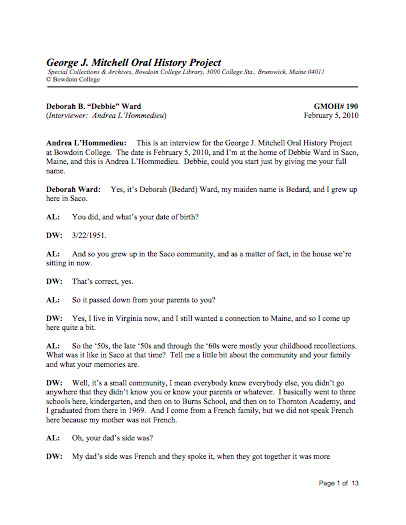
Interview includes discussion of: growing up in Saco in the 1950s and 1960s; splitting time between Virginia and Maine; reviving the Saco Young Democrats with Mike Aube and Barry Hobbins when Bill Hathaway ran against Margaret Chase Smith; campaigning as a part of the Young Democrats; being hired by Mitchell; Mitchell’s gubernatorial campaign volunteer base; working with Tony Buxton and Mike Aube; Mitchell’s running against and beating Joe Brennan in the primary; the state party structure; surprise at Longley winning the campaign; working as calendar clerk and assistant clerk for the state legislature; observing Mitchell’s progress to senator; and Joe Angelone.
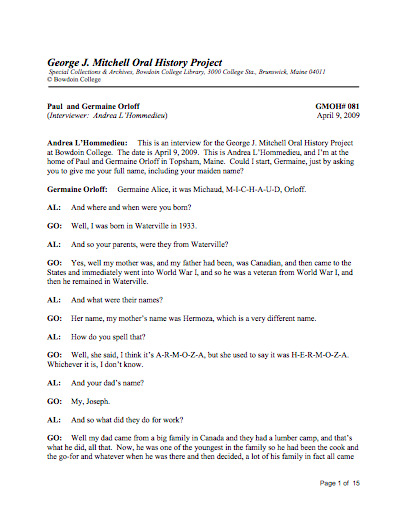
This interview includes discussion of: growing up in Waterville, Maine, in the mid-twentieth century; immigrant cultures in Maine; lower middle class experience in Waterville; the Mitchell family; Robbie Mitchell’s personality; Hollingsworth & Whitney; George Mitchell as a young man; George Mitchell’s dating; Bowdoin and Colby Colleges; participation in the Democratic Party; the Orloff family; activities at the Boys and Girls Club; memories about various members of the Mitchell family; tennis; growing up as first generation Americans; George Mitchell’s current activities; and local political activity.
Interview includes discussion of: growing up in Biddeford, Maine; attending Tufts University; working as a field organizer for Joe Brennan; making the transition to Mitchell’s staff; working as a legislative correspondent after Mitchell became majority leader; working on the Clean Air Act with Kate Kimball and Jeff Peterson; working with Mary McAleney; the bond among the staff members coming from Maine; her personal interaction with Mitchell; Mitchell’s approach to researching issues; how the younger members of Mitchell’s staff interacted; influence of Senator Mitchell’s office on her later career; Mitchell’s stance on environmental issues and climate change; and Mitchell’s relationship with Senator Dole.
Interview includes discussion of: working on Muskie’s campaign; the Dubord decision; working with Mitchell on Muskie’s staff; Mitchell’s 1974 gubernatorial campaign; Martin being elected speaker of the house in Maine state legislature; 1968 Muskie Vice Presidential campaign; 1970 Muskie Senate reelection campaign as treasurer; Martin working with Jim Longley; Martin’s reaction when Mitchell was appointed to replace Muskie; Mitchell’s ascent to leadership in the Senate; the importance of the Dickey-Lincoln project to northern Maine; the future of Aroostook County; the size of the legislature and the possibility of a unicameral legislature; and thoughts on Mitchell’s work in the Middle East.
Interview includes discussions of: meeting Senator Mitchell; Mitchell’s appointment to the Senate; Indian Land Claims Settlement case and its importance to the State of Maine; other colleagues on the Mitchell staff and their job responsibilities; Mitchell’s retention of Senator Muskie’s staff; leadership styles of Senators Muskie and Mitchell; conceptualizing and forming the George Mitchell Scholarship and Research Institute; and Mitchell’s strengths including: intelligence, compassion, gratitude, modesty, speaking ability, hard work, and dedication.